
Publications

Young Ng

Date published:
19 Nov 2025
Journal / Publisher:
Springer Nature
The Redstone Park of China: Mount Danxiashan
This book explores one of the world’s most striking red bed sandstone landscapes—Danxiashan—which was designated a UNESCO Global Geopark in 2004 and inscribed as part of the serial World Heritage property" China Danxia" in 2010." China Danxia" refers to a distinctive type of landscape formed on continental red terrigenous sedimentary rocks, shaped by internal geological forces such as tectonic uplift and external processes including weathering and erosion. Danxiashan is...

Authors:
Young Ng, Wolfgang Eder
geoheritage, geoparks, geotourism, China, geomorphology

Raíza Sartori Peruzzo

Melinda McHenry
Date published:
15 July 2025
Journal / Publisher:
Geomorphology 481(109770)
Land tenure and future development affect integrity and geodiversity in Brazilian Indigenous Geocultural sites
Indigenous lands in Central West Mato Grosso, Brazil, face significant threats from infrastructure projects, agricultural expansion, and illegal mining. This study evaluates risks of these, and other threats, to the integrity and geomorphic functions of geocultural sites in three Indigenous Territories (ITs): Tirecatinga, Irantxe, and Utiariti. We characterised site degradation and threats, applied threat assessment tools, and conducted a risk evaluation for these territories. Primary and secondary data, including oral histories from...

Authors:
Raíza Sartori Peruzzo, Jairo Valdati & Melinda McHenry
Indigenous lands, geocultural sites, threat assessment, territorial management, geoconservation

Mark Williams
Raiza Sartori Peruzzo
Date published:
16 Apr 2025
Journal / Publisher:
Computers & Geosciences, 105945
Geoscience popularisation in Geoparks: A common workflow for digital outcrop modelling
Geodiversity has gained increasing attention, prompting geoscientists to advocate for its recognition to promote holistic nature conservation. UNESCO Global Geoparks (UGGps) have expanded globally, promoting geoheritage and contributing to geoconservation and sustainable tourism. In this framework, the IGCP 714 project, "3GEO – Geoclimbing & Geotrekking in Geoparks," launched in 2021, aims to use Geographical Information Technologies (GIT) – including GIS, remote sensing, Unmanned Aerial Vehicles (UAVs), and...

Authors:
Mark A Williams, Gianluca Tronti, Raiza Sartori Peruzzo, Manuel García-Rodríguez...
3D digital outcrop models, virtual reality, GIS, geoheritage, geotourism, geoparks

Ruby Hoyland
Melinda McHenry
Date published:
28 Feb 2025
Journal / Publisher:
Fire 8 (101)
Modelling Relative Fire Sensitivity for Geodiversity Elements
The integration of geodiversity elements and contexts into fire management frameworks remains limited due to a lack of actionable tools for assessing geosite sensitivity. This study addresses this gap by developing and testing a mechanistic model to evaluate soil and lithological fire sensitivity, using a geodiversity database of Tasmanian geosites at various temperature thresholds. Initial results indicate the utility of the approach to distinguish between sensitive and robust geosites, providing a simple delineation between the...

Authors:
Ruby Olivia Hoyland, Melinda Therese McHenry
geoheritage, geosite, geoconservation, vulnerability, sensitivity, risk, hazard, wildfire, EIA, Tasmania, PCAs
Mark Williams
Melinda McHenry
Date published:
17 Jan 2025
Journal / Publisher:
Information Technology & Tourism 27 (2), 477-512
Optimising geotrail planning by leveraging least-cost path for sustainable geotourism development: a case study on a Tasmanian west coast post-mining landscape
Geotrails serve as educational journeys that highlight significant geodiversity and cultural heritage, offering recreational and interpretive experiences in a range of constructed and natural environments. There is a growing need for objective methods to support decision-making in geotrail design. The Least-Cost Path (LCP) method, a resistance-based model...

Authors:
Mark A Williams, Stephen Rolls & Melinda T McHenry
sustainable geotourism, geotrail planning, geodiversity, stakeholder design, GNSS field validation, LCP
Young Ng
Date published:
7 Dec 2024
Journal / Publisher:
Geoheritage 17(1)
A New Approach to the Interpretation of Geotourism Texts
The importance given to geotourism reflects public awareness of the urgency of environmental conservation that includes geomorphological, ecological, and cultural knowledge. The recent growth of geotourism has increased the demand for high-quality geotourism interpretation to ensure accurate data communication. Nonetheless, the lack of systematic t...

Authors:
Jason Li, David Wei Dai & Young Ng
geotourism, SSC model, interpretation, corpus-based method, eco-translatology
Raíza Sartori Peruzzo
Melinda McHenry
Date published:
21 Oct 2024
Journal / Publisher:
Available at SSRN 4990189
Geocultural Sites of Indigenous Territories in the Cerrado Region of Brazil
Geodiversity features prominently in cultural heritage. However, there is a scarcity of studies that consider geocultural values of geodiversity in academic literature in the global south, in part due to the legacies of colonialism, distrust, and loss of connection to landscape by younger First Nations peoples. A lack of known geocultural values can affect conservation efforts and impede efforts by Indigenous Peoples to use their lands in accordance with their values and desires for social, ethical, environmental and economic autonomy. As part of...

Authors:
Raiza Sartori Peruzzo, Melinda Therese McHenry, Jairo Valdati, Edivaldo Lourival Mampuche...
geoheritage, geoconservation, indigenous, Brazil, global south, First Nations
Mark Williams
Date published:
19 July 2024
Journal / Publisher:
Geoheritage 16 (3), 79
The IGCP 714 project “3GEO–geoclimbing & geotrekking in geoparks”–selection of geodiversity sites equipped for climbing for combining outdoor and multimedia activities
The IGCP 714 project “3GEO – Geoclimbing & Geotrekking in Geoparks” is financed by the International Geoscience Programme (IGCP) and supported by the International Union of Geological Sciences (IUGS). In this paper, we report on the results of the first phase of the project focused on the criteria to be adopted to select geodiversity sites equipped...

Authors:
Irene Maria Bollati, Anna Masseroli, Mohammed Al Kindi, Lucas Cezar... Mark Williams...
geodiversity, geoconservation, geoclimbing, geotrekking, 3D digital outcrop models, IGCP, UNESCO
Mark Williams
Melinda McHenry
Date published:
27 June 2024
Journal / Publisher:
Sustainability 16 (13), 5482
Australian geotourism discovery platform: a sustainable and user-friendly platform for accessible exploration of geosites, geotrails, cultural, and mining heritage sites
Geotourism focuses on an areas’ geodiversity and cultural landscape to provide visitor engagement, learning, and enjoyment. Geotourism is pivotal in achieving the Sustainable Development Goals (SDGs), as recognised by the United Nations. This study examines the development of the Australian Geotourism Discovery Portal (AGDP) and its role in...

Authors:
Mark A Williams, Xinyuan Wang, Melinda T McHenry & Angus M Robinson
GIS, digital platform, geotourism, Australia, SDGs, ArcGIS Hub, GIT, national tourism strategy
Ruby Hoyland
Melinda McHenry
Date published:
5 Apr 2024
Journal / Publisher:
International Journal of Wildland Fire 33, 1-24
Fire and geodiversity
Geodiversity elements contribute significantly to local and global hydrological, biogeochemical and ecosystem services and as such, fire is a potentially disruptive force with long-term implications. from limiting karstic speleothems formation, to compounding impacts of peat-fire-erosion cycles. Geodiversity elements additionally possess important cultural, aesthetic, and environmental values, including the support of ecosystem services. Hence, assessments of potential fire damage should consider implications for land users, society...

Authors:
Ruby Olivia Hoyland, Melinda Therese McHenry & Erin Anastacia Foster
fire management, deposition, fluvial, geoheritage, geosystem services, karst, landforms, soils, post-fire impacts
Young Ng
Date published:
18 Mar 2024
Journal / Publisher:
Journal of Sustainable Tourism 33(2), 207-242
Effective Chinese-to-English biotic interpretation in ecotourism destinations: a corpus-based interdisciplinary study
Ecotourism interpretation pertains to vital public education regarding environmental conservation. At present, there is no professional standard or system for interpretation in this domain, which potentially hinders the goals of geoheritage, and species preservation. To address this shortcoming, two categories of ecotourism (flora and fauna), are selected and broken down into the three main interpretation issues: common biotic names, local Chinese biotic terms, and ecological processes...

Authors:
Jason Li & Young Ng
ecotourism, interpretation, eco-translatology, corpus-based method
Raíza Sartori Peruzzo
Melinda McHenry
Date published:
1 Nov 2023
Journal / Publisher:
Descriptions and site characterisation VALUE
Ecological value (ECOL) Aesthetic value (AEST) Cultural value (CULT) Visit conditions Accessibility Security Site context Tourism infrastructures Education Interpretive facilities Education interest

Authors:
Raíza Sartori Peruzzo, Jairo Valdati & Melinda T McHenry
values, criteria, tourism, geoheritage, religion
Melinda McHenry
Date published:
11 May 2023
Journal / Publisher:
Land Degradation & Development 34 (13), 3867-3880
Informal camping on the margin of wild country: Early indicators of degradation and potential for some positive nature conservation outcomes
Wild areas provide a wide array of recreational opportunities in nature, including informal camping. We examined the potential for land degradation associated with informal campsites accessible by vehicle on the margins of the wild country on the Central Plateau of Tasmania, where alpine and sub‐alpine ecosystems with numerous glacial and periglacial wetlands...

Authors:
Busola Christianah Adedokun, Melinda Therese McHenry & James Barrie Kirkpatrick
degradation, soils, recreation, periglacial, TWWHA, camping, Tasmania
Mark Williams
Date published:
26 Sept 2022
Journal / Publisher:
16th European Geoparks Conference, Italy
New frontiers in Geotourism – the role of digital tools in the Australian context

Authors:
Mark Williams
Mark Williams
Date published:
4 Sept 2022
Journal / Publisher:
7th Asia Pacific Geoparks Network Symposium
3D Visualisation and Web GIS for public communication of geosites

Authors:
Mark Williams
Young Ng
Date published:
16 Aug 2022
Journal / Publisher:
Geoheritage 14, 93
Benchmarking the Quality of Chinese to English Geotourism Interpretation: the SSC Model Based on Eco-translatology
The global growth of geotourism has increased the demand and quality for geotourism interpretation. However, in its pioneer stage, geotourism interpretation has much ineffective interpretation, which hinders the informative purpose of geotourism. Moreover, geotourism interpretation lacks a systematic quality evaluation model. Such a model is essent...

Authors:
Jason Li, Fangzhou Zhu & Young Ng
SSC model, geotourism, interpretation, corpus-based method, benchmarking, eco-translatology
Young Ng
Date published:
1 Aug 2022
Journal / Publisher:
Springer Geography, Science Press Beijing
The Principles of Geotourism
The Principles of Geotourism (1991), compiled by Anze Chen, Yunting Lu, et al. of China Tourism Earth-science Research Association, is a summary of research findings of several 100 members of the Association in five years since its establishment, as well as a pioneering move of China’s earth-science workers to serve tourism and apply the theories and methods of earth-science to tourism. It basically reflects China’s research level of contemporary tourism earth-science. The publication of this work is of significance for both the earth-science...

Authors:
Anze Chen, Yunting Lu & Young Ng
geotourism, earth science, planning, tourism, China, assessments

Melinda McHenry
Date published:
1 Aug 2022
Journal / Publisher:
Fire 5 (4), 111
The fire and fodder reversal phenomenon: vertebrate herbivore activity in burned and unburned Tasmanian ecosystems
Very few multi-species or ecosystem comparisons of post-fire vertebrate herbivore activity and food preference exist to inform fire management and conservation strategies. We inferred post-fire (1–3 years) native and introduced vertebrate herbivore activity and attraction to six diverse temperate vegetation communities (grassland to rainforest) from scat counts. We hypothesised that where fire reduced herbaceous and grassy vegetation (‘fodder’), vertebrate herbivores would decline, and that post-fire preferences of native...

Authors:
David J Heaton, Melinda T McHenry & Jamie B Kirkpatrick
Australia, Tasmania, herbivory, macropods, soil moisture, grazing, blazing
Young Ng
Date published:
8 Mar 2022
Journal / Publisher:
Geoheritage and Parks 10(4), 27-46
Strategies and problems in geotourism interpretation: A comprehensive literature review of an interdisciplinary chinese to english translation
The steady growth of geotourism is increasing the demand for geotourism translation. Because in China geotourism is implemented mainly on the basis of geoparks and this study is Chinese to English (C-E) language based, this review uses Chinese UNESCO Global geopark data to explore the current status of geotourism translation. This comprehensive lit...

Authors:
Jason Li, Young Ng & Ruixue Wu
geotourism, UNESCO, geoparks, China, corpus-based method, eco-translatology
Melinda McHenry
Date published:
1 Jan 2022
Journal / Publisher:
University of Tasmania
A new major in sustainability: from research-informed development to interdisciplinary delivery
Sustainability Matters:
Higher education;
Health status (incl. wellbeing);
Environmentally sustainable information and communication services not elsewhere classified

Authors:
Emily Flies & Melinda McHenry
education, community of practice, pedagogy, sustainability, UTAS
Young Ng
Date published:
16 Dec 2021
Journal / Publisher:
Geoheritage 14(6)
Developing Culturally Effective Strategies for Chinese to English Geotourism Translation by Corpus-Based Interdisciplinary Translation Analysis
As a new field of translation with its own special genre, geotourism has not yet been firmly established because geotourism translations are currently not of a sufficient professional standard. This situation does not provide geotourists with the genre’s full target of enjoyment, learning and engagement through science popularisation tourism activi...

Authors:
Jason Li, Ruixue Wu & Young Ng
geotourism translation, eco-translatology, corpus linguistics
Mark Williams
Melinda McHenry
Date published:
1 Sept 2021
Journal / Publisher:
Geoheritage and Parks 9 (3), 294-312
Tasmanian reserve geoconservation inventory assessment using Geographic Information Technology (GIT)
Geoconservation is, at its foundation, a grass-roots movement with geoheritage represented by geosites containing the most scientifically significant and valuable geodiversity elements. Problems arise in the assessment and communication of inventory due in part to inconsistent and traditionally time-consuming, ‘snapshot’ assessments that are difficult to spatially monitor.
The case study of kunanyi/Mount Wellington and the encompassing IUCN Category II Wellington Park Reserve...

Authors:
Mark Andrew Williams & Melinda Therese McHenry
mountain, wilderness, diabase, UAV, recreation, Tasmania
Mark Williams
Date published:
16 Aug 2021
Journal / Publisher:
Historical Life Course Studies 11, 20-47
Reconstructing a longitudinal dataset for Tasmania
This article describes the formation of The Tasmanian Historical Dataset a longitudinal data resource spanning the 19th and early 20th century. This resource contains over 1.6 million records drawn from digitised prison and hospital admission registers, military enlistment papers, births, deaths and marriages, census and muster records, arrival and departure lists, bank accounts and property valuations, maps and plans and meteorological observations. As well as providing an account of the many different sources that have been digitised...

Authors:
Trudy Cowley, Lucy Frost, Kris Inwood, Rebecca Kippen, Hamish Maxwell-Stewart...Mark Williams...
longitudinal historical datasets, history of health, history of crime, GIS, demography, Tasmania
Mark Williams
Date published:
1 Aug 2021
Journal / Publisher:
Planning Tasmania
Bridgewater Bridge Project Geoheritage Impact Assessment
The purpose of this report is to provide an assessment of the potential impacts of the proposed Bridgewater Bridge on Geodiversity values in the vicinity of the development. The project is approximately 20km north of Hobart, traversing the Derwent River adjacent to the existing bridge between Granton and Bridgewater. This report has been prepared to respond to Section 4.9 (Geoconservation) of the Assessment
Criteria – New Bridgewater Bridge Major Project (May 2021), which are as follows...

Authors:
Mark Williams
geoheritage, GIA, impact assessment, Tasmania, geoconservation, geodiversity
Melinda McHenry
Date published:
19 Apr 2021
Journal / Publisher:
EGU General Assembly 2021, online, 19-30 Apr 2021
Scale and Value: Challenges in the assessment and representation of geodiversity in Australia
In this presentation, I present three case studies of Australian geodiversity. I first explore a regional interpretation of geodiversity, in a spatially-heterogenous protected area in Tasmania - a place that has myriad unique superlative natural values. I demonstrate that the delineation between elements of geodiversity is supported by a geological framework, that facilitates adequate rank comparisons of similar landforms and/or geological types across variable topography and vegetation communities. I then demonstrate the challenges associated with...

Authors:
Melinda McHenry
geodiversity, assessments, spatial extent
Melinda McHenry
Date published:
1 Apr 2021
Journal / Publisher:
Natural Resources and Environment Tasmania
Suitability of Ground Penetrating Radar for the assessment of soil depth in the Tasmanian Wilderness World Heritage Area
The purpose of this report is to detail the workflow, processes and relative success of using Ground Penetrating Radar (GPR) instruments to determine organic soil depth in the Tasmanian Wilderness World Heritage Area (TWHAA). Sites were strategically selected for their range of vegetation communities, altitude and aspects, geological substrates and natural values, in which to compare traditional hand-excavated and visual assessments of soil characteristics and depth to new, non-destructive GPR methods.

Authors:
Melinda McHenry, Vanessa Adams, Cameron Geeves, Ben Weeding
TWWHA, soils, world heritage, tools, GPR
Mark Williams
Melinda McHenry
Date published:
7 July 2020
Journal / Publisher:
Geoheritage 2020 12(63)
Geoconservation and Geotourism: Challenges and Unifying Themes
This paper documents the experiences of researchers and practitioners working in protected areas governance and management, geoconservation and geotourism, via semi-structured interviews of 30 geoheritage and geoparks researchers and practitioners. Using narrative discourse, we identified a number of challenges and barriers in conserving, practicing and managing geoheritage and geoparks. Divergence in the acceptance of geodiversity as a concept appears most preventative to the discipline in the areas of research/scholarship...

Authors:
Mark Williams, Melinda McHenry & Anne Boothroyd
perspectives, international, planning, terminology, tourism, geoheritage
Mark Williams
Melinda McHenry
Date published:
1 Jan 2020
Journal / Publisher:
Geoconservation Research 2023, 3(1), 17-32
The increasing need for Geographical Information Technology (GIT) tools in Geoconservation and Geotourism
In this paper, we review the progress on the use of GIT tools in geoheritage and geotourism to date, highlighting current gaps in practice. By way of an interview of prominent global geoconservation and geotourism professionals conducted in 2018, we show that approximately 25% of the surveyed workforce use some type of GIT tool to aid in decision support, decision making, or for communication(s) of inventory elements and features of interest. Upon review of the literature, it appears that the vast majority of tools are used...

Authors:
Mark Williams & Melinda McHenry
education, degradation, scientific value, tourism, drone, UAV, tools
Melinda McHenry
Date published:
19 Nov 2019
Journal / Publisher:
Plants 2019, 8(11), 523
A World of Gorse: Persistence of Ulex europaeus in Managed Landscapes
Using the PRISMA (preferred reporting items for systematic reviews and meta-analysis) method and a quasi-metanalytical approach, we reviewed the seminal ~299 papers pertaining to gorse management. We identified (i) the ecological characteristics of the species that predispose gorse to behaving invasively, and (ii) the success of management actions (from a plant ecological life history perspective) in reducing weed vigour and impact. A broad ecological niche, high reproductive output, propagule persistence, and low vulnerability...

Authors:
Nicholas Broadfield & Melinda T McHenry
woody weeds, fire, grazing, disturbance, cost-benefit, mycoherbicides, phytophagous
Melinda McHenry
Date published:
13 Nov 2019
Journal / Publisher:
Diversity 2019, 11(11), 216
Old Processes, New Movements: The Inclusion of Geodiversity in Biological and Ecological Discourse
This paper presents findings from a critical literature review of 299 academic journal articles and texts that define geodiversity values, or otherwise incorporate geodiversity or its derived elements and values as components of conservation. Contrary to previous suggestions, we have found that most geoscientists have united behind a single definition of geodiversity and applied it frequently in their primary and applied, geotouristic, research. Qualitative elements of geodiversity, including system support values and aesthetic appeals within...

Authors:
Anne Boothroyd & Melinda McHenry
geoheritage, geoconservation, GIS, geoparks, soils, rocks, minerals, landforms
Young Ng
Date published:
1 Nov 2019
Journal / Publisher:
Springer: ISBN 978-981-13-2537-3
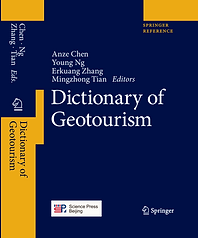
Dictionary of Geotourism
Geotourism is a new, emerging scientific discipline by applying the principles of earth science in the study of natural and human tourism resources. It involves the principles and methodologies of art, landscape architecture, environmental science and tourism in dealing with earth science issues of tourism activities and provides guidance to the es...
Authors:
Anze Chen & Young Ng
geotourism, earth science, geoparks, protected areas, PCAs, world heritage, China
Mark Williams
Date published:
1 Jan 2019
Journal / Publisher:
University of Tasmania
Using spatial technologies in geoconservation and geotourism
Conservation of novel, representative and diverse landforms, rocks and soils is termed ‘Geoheritage Conservation.’ Conservation of geoheritage is both popular and supported by robust assessment criteria in parts of Europe and China, where preservation occurs in UNESCO and local geoparks and via formalised inventory listings and conservation covenants. As geoheritage conservation expands as a discipline globally, it has become apparent that new tools are required to assist practitioners and researchers to communicate, remotely assess and detect...

Authors:
Mark Williams
geoconservation, geoheritage, GIS, drone, UAV, Tasmania, UTAS, UNESCO
Melinda McHenry
Mark Williams
Date published:
11 July 2018
Journal / Publisher:
IAG Conference 2018
Geoheritage - conserving novel landforms and processes in the Anthropocene
As we move into the Anthropocene, it has become more important than ever to identify and conserve notable geological and geographic features and processes of scientific, educational, cultural or aesthetic value. ‘Geoheritage conservation’ is the process by which significant geology and landform processes are recognised and protected. Yet geoheritage assessment criteria are diverse and sometimes subjective, and the emerging cohort of geoconservationists still face challenges in dealing with a lack of repeatable and robust methodologies.

Authors:
Jake Crisp, Melinda T McHenry & Mark Williams
geoheritage, landforms, assessments, Anthropocene, frameworks, geoconservation, values, geodiversity
Mark Williams
Melinda McHenry
Date published:
1 Jan 2018
Journal / Publisher:
University of Tasmania
A geopark in an Antarctic gateway city? The case for a Wellington geopark in Tasmania, Australia
Tasmania is an Australian island state with incredible geodiversity, second only to Scotland. State geoheritage conservation frameworks recognise over 1100 geosites of from sub-regional through to international significance. Tasmania is famous for hosting the world‘s largest exposure of dolerite, providing substantial evidence of continental drift and plate tectonics through its occurrence in the former Gondwanan supercontinent. Mount Wellington and the encompassing Wellington Park (250 km2) is a well expressed and accessible...

Authors:
Mark Williams & Melinda McHenry
Wellington Park, GIS, Tasmania, geoheritage, dolerite, geoconservation, periglacial, geotourism, UNESCO
Melinda McHenry
Date published:
1 Jan 2017
Journal / Publisher:
University of Tasmania
Strengthening engagement and collaboration for impact in the ERS theme
This study combined analysis of the University’s database of researchers active in the Environment, Resources and Sustainability (ERS) Theme area with a survey of 112 UTAS staff active in ERS research to understand the capacities of the ERS Theme and identify the most effective activities the Theme could undertake to encourage greater success in large research grant applications. The analysis identified factors that currently constrain collaboration with other researchers and engagement with stakeholders, essential features of interdisciplinary...

Authors:
Peat Leith, Melinda McHenry, Kerry Bridle, Jennifer Evans, Maree Fudge, Andrew Harwood...
environment, resources, sustainability, research, UTAS
Melinda McHenry
Date published:
10 Aug 2016
Journal / Publisher:
Acta Horticulturae 1123, 41-45
Plant root development as a measure of soil health
Healthy soil is of primary importance for sustainable vegetable production. Soil biology drives many of the soil processes that are critical to crop productivity, including deleterious effects associated with pests and diseases. While soil health is a much-studied field, most research has focused on soil biota and soil physical factors with little attention on the interaction between crops and the soil biology. Plant roots are the first sites of interaction between the plant system and soil biology, and their position at this interface potentially provides a direct measure of soil...

Authors:
S Pandey, P.B. Brown & M.T. McHenry
C:N ratio, soil respiration, organic matter, roots
Young Ng
Date published:
8 May 2015
Journal / Publisher:
The Principles of Geotourism (pp.253-261)
Prospects for Tourism Earth-science and Geotourism
An Introduction to Tourism Earth-science (Chinese Version, 1991) is a summary of the research findings of the Chinese Academy of Tourism Earth-science and Geopark Research since its establishment in 2009, as well as that of China’s tourism earth-science circle. It marks a new stage in the development of China’s tourism earth-science research. Howev...

Authors:
Anze Chen, Yunting Lu & Young Ng
geotourism, earth science, tourism, China
Young Ng
Date published:
8 May 2015
Journal / Publisher:
The Principles of Geotourism (pp.151-183)
Survey and Evaluation of Tourism Resources
China is vast in area and rich in tourism resources. However, for some historical reasons, not adequate attention was paid to tourism in the past, therefore considerable potential tourism resources have not been discovered and the resources already discovered have not been properly developed and fully utilized. With the rapid development of tourism...
View
Authors:
Anze Chen, Yunting Lu & Young Ng
Young Ng
Date published:
8 May 2015
Journal / Publisher:
The Principles of Geotourism (pp.131-150)
Principles of Aesthetic Appreciation of Sceneries
Scenery is defined both in broad and narrow senses. Scenery in broad sense refers to all beautiful natural landscapes or environments in which natural and cultural landscapes combine with each other, e.g. views hundreds of miles away, bridges and rivers ahead of courtyards; scenery in narrow sense usually refers to traditional scenic areas consisti...
Authors:
Anze Chen, Yunting Lu & Young Ng
landscapes, culture, aesthetic, China
Young Ng
Date published:
8 May 2015
Journal / Publisher:
The Principles of Geotourism (pp.1-24)
Research Objects, Tasks and Historical Development of Tourism Earth-science
Every science has its unique research objects. Tourism earth-science is no exception. Its research objects differ from those of geology, geography and tourism science, but also interact as both cause and effect with those of the aforesaid disciplines due to the characteristics of it as a marginal discipline. Despite insufficient understanding about...
Authors:
Anze Chen, Yunting Lu & Young Ng
geotourism, earth science, tourism, China
Young Ng
Date published:
8 May 2015
Journal / Publisher:
The Principles of Geotourism (pp.111-129)
Earthscientific Characteristics of Tourism Resources
It has been proved that the recognition, exploitation and utilization of tourism resources are inseparable from earth-science. However, at present relevant literature seldom discusses characteristics of tourism resources exclusively from the earthscientific perspective, but just touches upon earth-science in the discussion on tourism or features of...
Authors:
Anze Chen, Yunting Lu & Young Ng
geotourism, earth science, tourism, China
Young Ng
Date published:
8 May 2015
Journal / Publisher:
The Principles of Geotourism (pp.211-222)
Protection of Tourism Resources and Tourism Environments
Tourism environments are the sum of all external conditions of tourist activities, including social and political environment, natural eco-environment, tourism atmosphere environment and tourism resources.
Authors:
Anze Chen, Yunting Lu & Young Ng
nature reserve, National Park, PCAs, tourism, development, ecotourism
Young Ng
Date published:
8 May 2015
Journal / Publisher:
The Principles of Geotourism (pp.39-78)
Basic Formation Conditions of Natural Tourism Resources
Natural tourism resources are natural landscapes and natural environments available for enjoyment by man. They reside in a certain spatial position, specific formation conditions and historical evolution stages of nature.
Authors:
Anze Chen, Yunting Lu & Young Ng
geotourism, earth science, tourism, China
Young Ng
Date published:
8 May 2015
Journal / Publisher:
The Principles of Geotourism (pp.223-252)
Geoparks
As an innovative type of tourism destination in China emerging at the very beginning of the twenty-first century, geoparks are landmarks in the history of tourism earth-science (Chen 1998) functioning as newborn children in a new era. The birth of geoparks created a solid foundation for tourism earth-science in both theoretical research and policy...
Authors:
Anze Chen, Yunting Lu & Young Ng
geotourism, earth science, tourism, China
Young Ng
Date published:
8 May 2015
Journal / Publisher:
The Principles of Geotourism (pp.25-38)
Role of Tourism Earth-science in Tourism Development
Tourism is a huge social systematic project comprising tourism demand and supply systems and many subsystems, such as tourism regional system, tourism market system, tourism service system, tourism goods system and tourism education system. These parts, which are interdependent and infiltrate and constrain each other, constitute a complicated touri...
Authors:
Anze Chen, Yunting Lu & Young Ng
geotourism, earth science, tourism, China
Young Ng
Date published:
8 May 2015
Journal / Publisher:
The Principles of Geotourism (pp.79-109)
Earthscientific Formation Conditions of Cultural Tourism Resources
Although cultural tourism resources are a result of man’s cultural activities over time, their formation and distribution depend largely on natural environments and such factors as history, nations and ideology. Therefore, the territorial rules of the generation, development and distribution of cultural tourism resources are also research objects of tourism earth-science workers by virtue of the principles and methods of geology and geography. In this book, we just analyse the conditions in China
Authors:
Anze Chen, Yunting Lu & Young Ng
Young Ng
Date published:
8 May 2015
Journal / Publisher:
The Principles of Geotourism (pp.185-209)
Tourism Development Planning
Although tourism planning is a part of the general strategic planning system of the state, its complexity, hierarchy and scientific involvement are rarely found in other departmental planning, because, as a comprehensive undertaking, tourism have both its economic implications and its cultural contents. Economically, tourism involves industry, agri...
Authors:
Anze Chen, Yunting Lu & Young Ng
tourism, development, geotourism, planning
Young Ng
Date published:
1 Jan 2015
Journal / Publisher:
Springer: ISBN: 978-3-662-46696-4
The Principles of Geotourism
Research Objects, Tasks and Historical Development of Tourism.- Role of Tourism Earthscience in Tourism Development.- Basic Formation Conditions of Natural Tourism Resources.- Earthscientific Formation Conditions of Cultural Tourism Resources.- Earthscientific Characteristics of Tourism Resources.- Principles of Aesthetic Appreciation of Sceneries....
Authors:
Anze Chen, Yunting Lu & Young Ng
geotourism, earth science, tourism, China
Melinda McHenry
Date published:
16 Aug 2014
Journal / Publisher:
Social Psychology 44 (7), 736-742
" Reflective minds and open hearts: Cognitive style and personality predict religiosity and spiritual thinking in a community sample": Corrigendum.
We examined associations between two psychological constructs, analytic cognitive style and the personality facet ‘Openness to Experience’, and several dimensions of religiosity: religious affiliation, strength of faith and spiritual epistemology. In a relatively large (N = 1093), older community sample (M = 55.4 years), analytic cognitive style was associated with a...

Authors:
Matthew Browne, Gordon Pennycook, Belinda Goodwin & Melinda McHenry
psychological constructs, religion, cognitive factors, personality factors
Melinda McHenry
Date published:
Journal / Publisher:
The Effect of Location, Time, and Environmental Conditions on Fish Use of Southern Temperate Saltmarshes
Fish use of saltmarsh varies spatially, temporally, and with environmental conditions. The specific impact of these effects on fish assemblages in southern temperate Tasmania, Australia—the only mangrove-free Australian state—is as yet largely unknown. Seasonal variation in fish abundance, richness, diversity, and size was investigated in succulent...

Authors:
Young Ng
Date published:
Journal / Publisher:
NGO's role in the establishment of geopark and promotion of geoconservation: the Hong Kong example
A NGO can be extremely useful in assisting the government in the development of geopark and the promotion of geological conservation. The example of Hong Kong demonstrates the flexibility, efficiency and professionalism of a NGO which reinforces the government's determination to make possible the establishment of a geopark in Hong Kong. The NGO
Authors:
Young Ng & Cindy M C Choi
Melinda McHenry
Date published:
Journal / Publisher:
Supplementary Data for the Submitted Manuscript - Alignment of Mining Sustainable Development Goal Assessment with Geoconservation in the Seridó UNESCO Global Geopark, Northeast Brazil (Submitted to the Geoheritage Journal)
Authors:
Young Ng
Date published:
Journal / Publisher:
Hong Kong Geopark uncovering the geology of a metropolis
An outstanding collection of international case studies that provide insight into and suggest best practice for issues such as conservation, risk management, education, marketing, interpretation and technology of actual and developing geotourism sites.
Authors:
Young Ng, L.W. Fung & David Newsome
Young Ng
Date published:
Journal / Publisher:
Hong Kong Geopark: Uncovering the geology of a metropolis
This chapter describes the issues and processes surrounding the development of the Hong Kong geopark and provides a brief account of the main geotourism resources of Hong Kong. The possibility of establishing a volcanic geopark in Hong Kong was first mentioned in a seminar at the Hong Kong University in 2005 by some Chinese geologists. However, the..
Authors:
Young Ng, L.W. Fung & David Newsome
Young Ng
Date published:
Journal / Publisher:
Petrological study of high Island formation volcanic columns in the Hong Kong National Geopark
Hexagonal columns (columnar joints) of Cretaceous High Island Formation (Kkh) volcanic rocks make up the key landscape of the Sai Kung Volcanic Rock Region in southern Hong Kong National Geopark, but whether they belong to lava or pyroclastic rock has been disputing. On the basis of field geological investigation and rock thin section observation,...
Authors:
G.-F. Xing, Young Ng, K.-Y. Tao ...
Young Ng
Date published:
Journal / Publisher:
GEODIVERSITY AND GEOCONSERVATION IN HONG KONG
Geodiversity refers to the diversity (or variety, range) of geological (rocks, minerals, fossils), geomorphological (landform) and soil features, and their assemblages, relationships, processes, properties, interpretations and systems. Despite there is a limited area of 1108 km, Hong Kong has a remarkably rich geodiversity that includes diversified...
Authors:
Sai Leung Ng, Jiangfeng LI, Shiming FANG & Young Ng